The Night before the Flight


Here we are, just about to launch the serialization of my play Bombardment. It’s kind of like the night before the mission. Which means I need to speak with the troops.

So. To my potential readers, I hope you have fun. It’s a weird kind of fun, but still….

As for potential theatre-makers who read it, I know that by publishing the play through a blog, I’m more or less giving it away. But, for what it’s worth, here are my ground rules, which admittedly operate on the honor system (not particularly appropriate for our times, but one can hope).

I own the copyright on this thing, flat out. If some of you actually want to do something with it–put it on as a reading or production–you can do so royalty-free. I do ask that you inform me first of the production, and, if comes to pass, I’d appreciate your sending me reviews, playbills, publicity materials, and the like (electronic documents will be fine). If you put it on, make a few dollars, and want to share some with the playwright, great–that would be kind and gracious. Not because I’m greedy or expect to ever make money off this play, but because artists of all levels deserve to be compensated for their work.

What I ask you not to do is this: don’t produce the play under a different title or with a different author’s name; don’t produce it without citing me as the author; and don’t change the words or scenes.

Use of the play does not extend to film or broadcast. Plays are meant to be performed. Live. In front of a live audience. If you shoot a short segment for Youtube or the like, say for publicizing the play, please contact me first, and please don’t run it without my permission. And if anyone’s crazy enough to try to film this monster, we need to talk.

Finally, Bombardment is play for mature audiences, given its language, ideas, and imagery (particularly its violence, sexual content, and nudity). If you’re underage, really, you shouldn’t be producing it. If you must, please first consult with a responsible adult. And, not to sound pretentious or make the play sound overly important, if you’re an artist living under a repressive regime, please use caution before committing to the play. I don’t think it could get anybody busted, but I’d feel like hell if it did. It’s just a play. (Sort of.)

In other words, I hereby waive any responsibility for any trouble this play gets you into. Seriously.

If you have questions or want to send me comments, I can be reached at splatterson@mindspring.com

I guess that’s it. Tune in tomorrow, when the Bombardment commences. The engines are warmed up.

[To be continued]

Closing in on the Target


As I announced a couple days ago, Splattworks, over the next few weeks, will be serializing my drama Bombardment in bite-sized installments. It’s not an entirely new idea: Dickens serialized many of his novels before publishing them as the books we know today. Technology now allows me to do the same—amazingly—all around the world. Because I know you’re out there, in L.A. and Savannah and Hong Kong and Jordan and Brisbane and Berlin and….

Why this play now? The last decade has been so turbulent, terrible, and sometimes downright bizarre, that it’s come to feel like one, long, unbroken disaster, where one never knows when or where the next airstrike’s coming in. Every day makes history; some days are just bigger and more unsettling than others. Lately, they all have been.

It also feels like we’re coming up on one of those decisive moments, where we can pull up at the last minute or disappear into darkness, where the disparity between rich and poor has grown so great that society’s seams are splintering. Not just in the United States, where I live, but everywhere. The planet itself seems to be shaking and baking itself to pieces. The future, to me, has never felt so unknowable. The times, it seems, have caught up with Bombardment. So I hope readers find something in the piece that they can keep for themselves, even if it’s just an image or a line here and there.

To me, the play still seems a wild child. With time and experience, I can see a younger writer trying to find his way. Like a musician coming to competence, he has to try a little bit of everything and work through his influences. So there’s some Beckett here, along with some Ionesco and Albee, a touch of Brecht, and whole hell of a lot of Shepard, particularly in those epic monologues. I was still learning to let characters talk to each other.

If nothing else, I hope Bombardment’s a diverting read. I’m just happy to take a breath and let it off the reins. Maybe something interesting will happen. Or maybe it’ll just run over the top of the hill, and never be seen again. Putting it out there feels a little…edgy. Exciting. Kind of like an opening night. And that’s what theatre…and all art…should be about.

One more bit of business, and then the play should begin on Saturday. Thanks.

[To be continued]

Commencing Bombardment

Back in the early Nineties, we had ourselves a perfect little pocket war, known as Operation Desert Shield, the only U.S. war, so far, to sound like a feminine hygiene product. It was a swift, unforgettable thing, with CNN broadcasting live footage of Scud missiles falling on Tel Aviv, our wealthy friends, the Kuwaitis, getting looted by another one of our wealthy friends, one Saddam Hussein. Back during the Cold War, we weren’t always too choosy about who we took up with, and, as often happens, some of our relationships ended badly.

Seriously, it was a terrible war, with real bombs, blood, and bodies, and there was nothing amusing about it. I keenly remember feeling an awful sense of despair, as it became readily apparent the violence was inevitable, with no true certainty how it would turn out. Just as with its sequel, Operation Desert Storm (like most sequels, even more of a bummer), there were legitimate fears the war would set the entirely Middle East ablaze and completely destabilize the world economy. We’d have to wait another decade for that to happen.

History felt like an irresistible wave, a tsunami that rolled over everyone, no matter where they lived and how much money they did or didn’t have. The sense of fear and helplessness haunted me long after we’d tucked everyone back in their boxes, and I dealt with it the way writers do: I picked up the pen. In this case, I wrote a two-act drama called Bombardment.

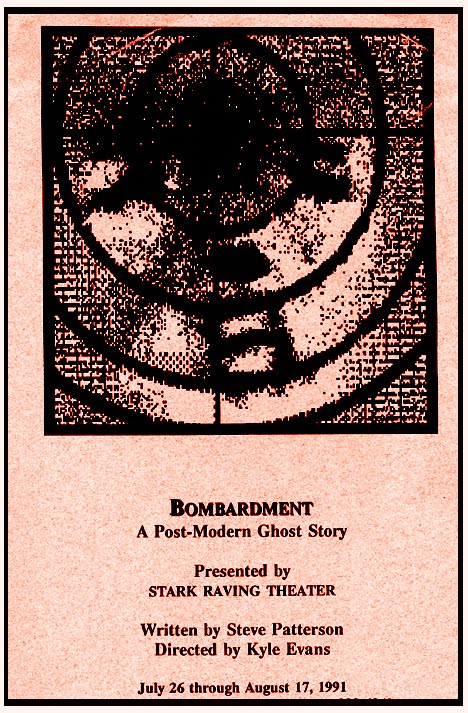
At that time, I’d become friends with some wickedly clever artists running a new Portland Theatre Company, Stark Raving Theatre, and I asked them if they’d take a look at it. You know, just to see what they thought. They said, sure. And the next thing I knew, we were building a set. That’s the way theatre ought to be done–by the seat of your pants, with absolutely no idea what you’re getting yourself into.

The four-actor play–two men, two women–was directed by the very talented Kyle Evans, and ran for six weeks. It took a typical trajectory for a new play by a then-unknown playwright: a great opening (when everybody’s friends and family showed up), struggling weeknights, but stronger weekends. Reviewers were puzzled, dismissive, or both, but word got around that the play was a wild little beast, and really different from anything else running in town. Weekend audiences began to grow, and we closed strongly.

A year later, I tried to hide myself in a plush theatre seat at the Oregon Book Awards ceremony (Oregon’s top literary prize), absolutely terrified that Bombardment, one of three Finalists, might actually win, and I’d have to say something in front of a bunch of writers much more distinguished than myself.

It didn’t win (it’d be almost 20 years before I’d finally bring the OBA home for Lost Wavelengths), but the Bombardment experience really set the hook: I wanted to keep writing plays. For good or ill (depending on who you ask), I’ve been doing it ever since.

So I’ve always had kind of a soft spot for Bombardment, even though it totally screwed up my life. The play was just so . . . out there. I was so new to playwriting, I didn’t even know how many rules I’d blithely shattered. Bombardment was like letting the horse loose, holding on, and just marveling at its power while trying not to worry about getting killed.

Over the years, as I’ve honed my craft (supposedly), I’d dig the play out of the files, work on it a bit, maybe shop it around to a few theatres, maybe put it back in the folder. I came to accept it just wasn’t the kind of play for bigger theatres–the kind afraid of possibly alienating their subscription base. It was just too jagged, non-linear, brutal, and, frankly, weird. It’s a play for theatrical buccaneers.

And that’s why we’re here.

[To be continued]

Blame it on Radiohead


Kris Kristofferson used to do a song called “Blame it on the Stones,” back when moms and dads worried about the Rolling Stones destroying Western Civilization™ and running off with their daughters. All that trouble and mess and uncomfortable dinner conversation, it was all because of some damned artists.

That was some time ago; so, to stay a little more current, we’ll go with Radiohead to blame pointlessly, even though they’re more likely to discuss Western Civilization™ in depth over a nice cup of Earl Grey.

They have been a bit…subversive, however, in launching their last couple albums. The gorgeous In Rainbows was offered on a pay-what-you-will basis through their Website www.radiohead.com. The recent lush, wonderfully strange King of Limbs sells similarly through the Web, for a straight-up $6.00 U.S., and, shortly after release, the band threw in a couple extra songs (which, refreshingly, are very good).

So. In the spirit of skipping the middleman and gatekeepers, and going straight to the people who matter–the audience, I’m serializing one of my plays, a full-length drama in its entirety, right here on Splattworks. For free.

I’ll be presenting further details over the next few days, but here’s the news:

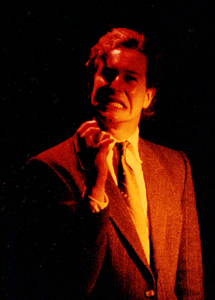
Splattworks will publish sequential excepts from my somewhat experimental, very dark, and brutally surreal drama BOMBARDMENT, an Oregon Book Award Finalist. (Above is a production still from the 1991 world premiere.)

Why that play released at this time will be explained. Paraphrasing a better-known playwright, also writing about one of his plays, there actually is a method to the madness…if a little madness to the method.

But, for now…blame it on Radiohead. Or, as Radiohead might say, blame it on the Black Star…which is where this play definitely lives. On that, more tomorrow.

[To be continued]

Another Shade of Dark

My plays have never been known for being especially frothy. Blue is, apparently, my favored color–in clothing, language, and music. I suppose that reflects my outlook. Humor, however, serves an an antidote to the blues, on-stage and in life, so I try to find it even in the heaviest work. Another requisite in tackling the serious is to do it very, very well. I don’t know that I’ve succeeded in that, but, believe me, I have tried. Serious themes deserves the best, and I’ve spent many sleepless nights wondering if I’ve done the work justice.

The last few years, I’ve largely focused more on the fantastic: plays exploring the psyche or utilizing magic realism or alternate realities, and I’m turning, also, to exploring the human condition through our relations to the arts, of late writing about music and photography. But, for a good number of years, I was known as the “war guy.”

That is, I wrote a series of plays–four in all–about war and its aftermath. Three explore the subject through the characters of journalists: Waiting on Sean Flynn (Vietnam); Liberation (Bosnia); and Depth of Field (Liberia, Sierra Leone, and 9/11). Reporters, serving as our eyes and ears during conflicts open a breathtaking, immediate window into war narratives. Plus I used to be a reporter–never a war correspondent, though (I get asked)–and I have great admiration for those who put themselves at risk to the show the world the cruelties of which we are capable. They’re also damned interesting people, which makes them fun to write about.

Flynn and Liberation have been successfully produced multiple times (and Liberation has been published by Original Works Publishing). Depth of Field remains in progress. I’ve finished a number of drafts, but I still haven’t quite cracked the code on that one. I haven’t given up, either.

The fourth play, Next of Kin, stands as a sort of coda to the trilogy, shifting the focus from reporters to soldiers and their families, whose vital stories I felt remained somewhat unaddressed by the other plays. Next of Kin, looking at Iraq, is also the most contemporary work. It’s a good, strong play, I think, which had a very successful staged reading last year with the splendid folks at Portland Theatre Works; I’m currently shopping the premiere to theatres around the country.

Though I never planned it, the plays developed their own arc. Flynn asks why we’ve come to war, and whether we should stay or go? Liberation, acknowledging we’re trapped in war, asks how much do we sacrifice to tell the story? Depth of Field asks whether, after surviving war and paying the price, why return. And Next of Kin asks what we do and who we are when its over.

Writing these plays has been, I think, a substantial, unique accomplishment. (I have kind of a dream of having them collected in a single volume someday. Maybe it’ll happen, though it’s hard to say, given the state of both theatre and publishing these days.) I didn’t set out to do it: it just happened. They’ve made me a few bucks along the way–not very much. But they have rewarded me, however, so richly in terms of experience, introducing me to people and places I’ll never forget (and never want to, even when the memories are ghastly).

They’ve given me a chance to work with brilliant directors, actors, and designers on a subject that seems to bond artists they way soldiers and reporters bond in the field: everyone knows this is a serious, important issue that demands our best, and the subject tends to strip away our bullshit because, let’s face it, it’s about living or dying, killing or being killed. When you work like that, you get down to the core of your collaborators, exposing who you really are, and it’s one of the primary reasons I have such deep affection and admiration for those who work in this tough, sometimes ephemeral business. If you’re lucky, you’ll learn to like your colleagues, and they become your friends; if you’re really lucky, you’ll come to love them.

The plays have also afforded me some of the most intense audience interactions of my career. During ther performance, the theatre feels beyond electric, the air supercharged. Total strangers, speaking to me after shows, have told me stories they may have never told their families. After a performance of Liberation, a Bosnian woman told me how she walked, barefoot, away from her hometown as its men and boys were being systematically slaughtered. And then she thanked me for having the courage to tell the truth. Never, ever have I felt so simultaneously honored and humbled. That moment remains a treasure I will carry to my end.

Finally, this subject has allowed me to talk to and exchange letters and e-mails with with veterans and war correspondents, which has been worth every minute of sweating through the work, worry, and heartache that comes with making theatre.

I feel these plays have deepened my soul. When I pick up the morning newspaper and read so-and-so many have been killed or wounded wherever they’ve been killed or wounded this day, the pictures and feelings that come to my mind may be different than yours. Not better or worse, just…different. If you have a heart, you can’t write about war without it changing you, and you can’t write about war effectively if you don’t have a heart. Sometimes I think it’s damaged me, you know? Just a little. Knowing a little too much about the worst humans can be and the most terrible things that can happen to us. Whatever I’ve learned and kept inside, It’s nothing compared to those who have been there, and it’s paid me back more than I could ever imagine.

This Memorial Day, as we approach the 10th anniversary of September 11th, I just want to take a moment thank all those who have served–and those who have reported the world’s self-inflicted catastrophes–for putting your very lives at risk. That’s it. A small and quiet acknowledgement that’s but a pebble in the ocean compared with your experience. With a special thanks, from as deep as I can reach, for those who have been so gracious to share your best and worst stories with me.

Here’s to the day when all our work becomes obsolete.

Seeing Around Corners


The unmistakable clean, sharp cutting guitar tone, with just a little hair on it. Enough to catch. Hook. The sound of Robbie Robertson’s new album, “How to Become Clairvoyant.”

A very cryptic title, that one. Honestly, I didn’t care for it when I first heard of it. It sounded just a little…corny. The title song, it turns out, is stone brilliant, and you don’t get to it until the next-to-last song. Robertson doesn’t give it up just like that. Like a good writer, he knows to make you wait.

The last song is a tribute to Django Reinhardt, who, along with Robert Johnson, seems to vie for the ultimate guitarist’s guitarist (even Les Paul bowed to him). This song bears close listening, particularly the end. And no, I’m not telling why.

I’ve liked all of Robertson’s post-Band albums, some more than others, as with all artists. “Somewhere Down the Crazy River” and “Skinwalker” are among Robertson’s best songs–a very high bar when you consider what he’s written.

This album, though, reflects a mature artist both living in the present and looking back with clear eyes. He never was The Band’s strongest singer–then again, the other guys were some of the best singers in popular music–but he has his own, distinctive tone and phrasing, and here he’s comfortable with what he can and can’t do, using his strenghts. Eric Clapton plays on about half the tracks (and co-wrote a couple, plus one instrumental’s all his writing), and Robertson seems to bring out the best in Clapton, who’s an artist who seems to thrive when collaborating.

A couple songs slip into cliches lyrically, but Robertson, like Bob Dylan, seems keenly aware of those cliches, and uses them as tools rather than crutches. There are enough songs full of original writing that there’s no fear Robertson’s slacking. Rather, he’s having fun. If you take those songs that way, you will too.

Besides the title cut, some of the killers here are “He Don’t Live Here No More,” “Won’t Be Back,” and, especially, “This is Where I Get Off.” The latter reflects the end of The Band, which, over the years, has prompted some resentments toward Robertson, particularly in Levon Helm’s very good autobiography.

It’s tough when you separate from an artistic collaborators. Close artistic partners usually have to become friends just to survive together, much less accomplish anything. You spend substantial time with them, sometimes under great pressure, and you learn their strengths and weaknesses, which you rely on or compensate for (as they do with you), resulting in a unique, complex affection. You can hear that tenderness–and pain through severance–in Robertson’s vocal. I think it’s fair to assume he misses what The Band could do as much as his listeners, but he knows it belongs to the past, especially as Richard Manuel and Rick Danko have passed on.

There’s a hint, though, of Manuel’s ghost in “This is Where I Get Off.” The album’s strong backup singers, particularly on that cut, echo The Band’s great harmonies without imitating them, including a haunting falsetto counterpoint to Robertson that recalls Manuel’s gorgeous voice, which could pull off a falsetto as well as the best Motown singers. It doesn’t come in until that song’s powerful, final chorus, and Robertson’s too careful and smart an artist for it to be coincidence. It’s heard but briefly, leaving Robertson to finish the song alone.

As it should be.

Quiet Genius

There’s this comic strip, Cul-de-Sac, which is simply…wonderful. Because it’s weird and charming and doesn’t want to be anything more than it is, which is weird and charming. A guy named Richard Thompson writes it–not the guitarist–and his drawings are weird. And charming. And the whole thing is a bright spot on the comics page. (Props to “Pearls Before Swine” too.)

Turns out Mr. Thompson maintains a humble blog through blogspot. Guess what? It’s weird and charming.

Richards Poor Almanac

Congratulations, Mr. Thompson: you do good work. Please keep doing it.