Bombardment, Episode 10: Orange Dust Obscures the Sun

Splattworks continues its presentation of Bombardment, a two-act drama by Steve Patterson. The author will attempt to post an installment each day, but, if events intercede, installments may occur a day or so apart. So please be patient.

[EPISODE 10]

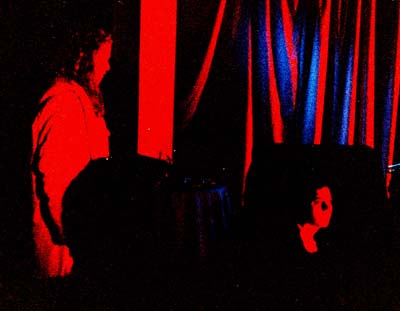
ARETHA: Well! I must look a horror, playing tag with death, and then tangled up with the like of you. Draw my bath. And not so hot this time! Nearly scorched my skin loose last time. Can’t have loose…. It isn’t is it? Do you see loose skin, Carmelita? Can you see my skin’s on tight?
CARMELITA: I can’t see, ma’am, that a thing has changed.
ARETHA: Relief! Change is so disquieting. Must gather oneself. So much to do, you couldn’t possibly imagine.

ARETHA tries to rise, but she’s too weak.

ARETHA: Carmelita. My legs. There’s something wrong with them. Are they supposed to bend this way? I can’t stand. Carmelita, I can’t stand! Help! Help me! I’m so. . .alone! Mr. Corno–
CARMELITA: Corno sleeps.
ARETHA: You. Of all people. Could be cruel to me.
CARMELITA: I have been taught so well.
ARETHA: You don’t under…. I can’t…trust. Everything’s a cross, double, triple-cross. Was it always thus? Why? What happened? This can’t be what we…. I don’t understand. I’m so small.

CARMELITA hesitates, helps her to her feet. ARETHA clings to her. CARMELITA brushes her hair back.

CARMELITA: Once, this face was kind.
ARETHA: Was it? I can’t…. It seems like a nice thing. To be way. But, too, it feel dangerous.
CARMELITA: Right now, face to face? This seems like danger?
ARETHA: Well, no. Of course. Yes. A little. Perhaps much. I’m getting littler, Carmelita.
CARMELITA: It’s as safe–or dangerous–as you choose to make it.

Pause, and then ARETHA melts into her. They hug, rocking back and forth, and, in a burst of exuberance, genuine joy, spin around until they trip over CORNO.

ARETHA: Corno!

ARETHA drops to her knees. As CARMELITA narrates, ARETHA reacts to her words.

CARMELITA: First is disbelief. Refusal to accept. As if doing so prohibits tragedy. “I can’t believe it.” “You must be joking.” “Tell me you’re joking.” This stage can last the rest of your life. Second is numbness. Stupefaction. Your arms are stupid. Your legs are stupid. Your toes and fingers forget how to work in concert. Your skin dries, cracks like burnt paper. Your chest shrinks, a buckskin drum rattling rice. Scent of oysters in the wind. On the horizon, orange dust obscures the sun. Third, there is anger.

ARETHA rises.

ARETHA: You did this!

[To be continued]

Bombardment, Episode 9: Oozing and Open

Splattworks continues its presentation of Bombardment, a two-act drama by Steve Patterson. The author will attempt to post an installment each day, but, if events intercede, installments may occur a day or so apart. So please be patient.

[EPISODE 9]

ARETHA: You what?
CARMELITA: You were so unhappy! So weary! To help, to ease your suffering, I…put them in your brandy, Aretha.
ARETHA: Do not speak my name!

Slaps CARMELITA hard.

CARMELITA: As you wish. Ma’am.
ARETHA: My question. You are here. In my bed. Now. Barely dressed. Explain this.
CARMELITA: Yes. After the…in the. . .night. You try to sleep, your eyes closed. Your head side-to-side. Your breath fitful. All you can do is call Corno. Mr. Corno. Come home. Finally, sleep descends, easing round the castle. Servants sigh. Dab their eyes. Prepare their own beds. Then the cook says, the phone! If the phone rings! So we run to your room, and your head is thrown back, your mouth is open, your skin is blue! Behind your eyelids, your eyes flicked back and forth! Panicked. Searching. Dreaming. She’s dreaming, says the cook! She’s dreaming of Mr. Corno! She’s chasing him in her dreams! Chasing after love! Quiet her, Carmelita. Quiet her before her heart bursts. How do I do this? What do I do? The servants, they grab me. They pull from me my uniform. Force me into bed. Beside you. I say this is wrong! I am soiled! But you are cold! Frozen cold! The touch–my touch–does something. Warms you. Calms you. Quiets you. Your breath turns to fuchsia. Your spirit to green. Stars return. Here. At this intersection of dream and desire. Your sweat blending with mine. Our tears. Our breath. For a moment…peace.
ARETHA: I see. How very creative of you. But I know. Why you’re here. Who you wait for. You exploit my confidence, poison me with your drink and medicines, and your perfect tales of selflessness. Then have the gall to wait, an orchid, oozing and open, for him. Blooming beside my rapidly cooling corpse.
CARMELITA: No, ma’am. I would never–
ARETHA: You already have. Remove your oily stench from my bed. And conceal your hideousness. At once.

CARMELITA rises.

CARMELITA: As you command, ma’am.

[To be continued]

Airing the Laundry

Fascinating post from the Parabasis blog. My first read of it left me cross-eyed and despairing (especially since I’m trained as a journalist), but another part of me feels defiant: fuck that shit. Let ’em get their MFAs…I got plays to write.

Life is short, baby.

————————

The Delusion Driving Much of American Theater

The Artful Manager has athought-provoking post up about The Amateur Vs. Professional divide in the arts in the age of the internet. He also quotes Clay Shriky’s Here Comes Everybody, which I happen to be reading right now (and really, if you care about blogging or want to understand the internet’s impact on society, is a must read). He ends it by asking this question:

what is the role of the expert and the excellent in a distributed world? How do we preserve space and return value to those who are extraordinary (by whatever measure you pick)?

I don’t think that’s a professional/amateur question — although that’s the frame we tend to use. In fact, I think the professional/amateur debate in the arts is clouding the deeper conversation.

This is worth thinking about in theatre, because our current system largely rewards club-house membership, not excellence, and it’s because we have increasingly established and codified paths to being deemed a professional that have to do with attendance of the correct schools, interning at the correct summer festivals, (and having the money to be able to do so) etc. and only somewhat to do with doing good work. This is only growing more problematic as many cities have LORT “professional” theaters that are outnumbered by “pro-am” theater companies (and by Pro-Am I mean theaters and artists doing professional quality work for amateur wages and largely in an amateur environment). Portland, Oregon has two LORT theaters and over a hundred Pro-Am companies. LA’s theatre scene is almost entirely ProO-Am, as is San Francisco’s. A large percentage of DC theatre is Pro-Am, as is Chicago’s and New York’s. In fact, I’m pretty sure in terms of number of productions, the majority (or at least plurality) of theatre produced in this country is probably Pro-Am (and i use this term to distinguish it from truly amateur productions such as community theatre).

And here’s the thing: most of the artists working in the Pro-Am circuit have very very little chance of crossing over. They are, essentially, pursuing a delusion as a result of a category erorr, namely that the Pro-Am circuit and the LORT/Institutional circuit are part of the same system. They are not, or at least, it’s more helpful to think of them as two sepearate systems. The path to working at LORT/Institutional theaters lies not in the Pro-Am circuit. it lies (largely, i know there are exceptions) in the institutional circuit, in interning at Humana, Apprenticing at Williamstown and going to UCSD or Yale (there are other paths out there, but this one is the clearest). Why is this? Because as theater has professionalized over the last fifty years, it has also adopted a Shadow Professional Certification System. It’s a shadow system because it’s largely social in nature; you don’t have to pass a writing bar exam to be a playwright, but if you want to make a living doing it, you probably need to have gone to one of seven graduate programs. And I’m not going to say there’s no relationship between Shadow Certification and Quality… there is, it’s just not 1:1. There’s plenty of terrible artists out there with MFAs from Yale (and awesome ones too, don’t get me wrong).

If we want to understand what’s going on in theatre in this country, we have to start looking at the Pro-Am circuit as its own beast that interrelates but is separate from the LORT-Institutional system. For one thing, we need to start studying it. There are very few studies out there of this world. The NYTIF is doing yeoman’s (or, I suppose yeowoman’s) work in documenting the scene here in New York, and I know David Dower will be presenting findings on this at the NEA NPDBlog over at Areana’s website.

I also think (and I’m trying to develop this into a larger and longer piece to be published elsewhere) it’s in the LORT systems’ best interests to try to find ways to learn about, be more involved with and collaborate with the Pro-Am system and start to break down the walls a bit. Why? Because, well… we have the audiences they want, the creative energy they need and the next generation of artsits likes working with us. I don’t recall The Vampire Cowboys ever complaining about their audiences being too old, or too white, or not passionate about the work they do. And Youngblood doesn’t have any problem getting people of all ages and races to come watch ten minute play festivals on Sunday mornings in the middle of winter and their space is a brutal, windy walk from the C/E train and roughly an hour away from where most of their spectators lives. In discussions with playwrights, they indicated a strong preference for working with theatre companies like Crowded Fire in San Francisco, who perform their shows in a space with less than fifty seats for fewer than twenty performances.

… adding I should also say that on some subconscious level artists working in ProAm know this already. When you talk to your friends in New York who want to quit New York and move to a smaller city, it is generally NOT to work at a LORT theatre there but rather to found their own theatre in the hopes that it will become a sustainable endeavor someday.
ACHTUNG!

If you’re a playwright or care about the birth and life of new plays, you HAVE to read the recent posts at Parabasis. Check it out….

here

Here’s some of the meat:

Theaters:

–Consider themselves one flop away from folding

The following statistics are self-reported, and are probably somewhat skewed due to the selection-bias of the survey (i.e. they only surveyed theaters that produced new plays):
— New plays account for 45.6% of offerings on our stages
— 23.8% are world premieres
— Fewer than 2 shows a season are 2nd productions

–Prevalent emphasis on world premieres are helping to strangle the new play system

–1 in 5 theaters regularly seek new plays that have already premiered

–As a result: the writer/agent want to get as big a world premiere as possible if they want the play to have a future life. This drives them back into the big institutions that they find problematic in the first place

–Culturally specific theaters have to compete with large theaters for multi-cultural grants and frequently become “farm teams” for the artists who will be included in the “multi-cultural” slot at larger theaters

–Expectations have been downsized. Small spaces, small casts.

ACCESS:
–How do plays move through theaters? How do good theaters shepherd this process?

–Lack of Artistic Director access is frequently discussed. It is playwrights’ biggest perceived problem

–Pass-blocking of admin staff, particularly lit depts.

–Most ADs agree that access is the key… so… “how can writers + ADs build relationships?”

–How much do agents help? (this part is tricky, data-wise, i’m gonna try to get it right):
-62% of playwrights had at least 1 play produced from direct submission to theater.
-83% have had 0-1 produced from agent submission
-Only roughly 5 agents are well regarded

–55% of playwrights think formal difficulty is the thing that is most likely to sink their plays

–ADs, on the other hand, rank cost and production demands as highest factor

–“Everyone wants the same 10-20 playwrights, and those writers are backed up with commissions”

Another Modest Proposal

So the catchword these days is “transparency.” Obama’s going to put the budget online so taxpayers can look it up, to see how their tax dollars are spent (provided they have time to search through all 700 pages or so). The bank “stress tests” will show which banks are healthy and which need to capitalize to survive tough economic. We’re all striving to be as transparent as ghost shrimp.

So….

Here’s my suggestion. Theatres, large and small, should post on their Web sites a breakdown of how your ticket’s spent.

I’m not saying actual amounts. That’s proprietary information, affected by private salary and contract agreements, and so on. I’m just saying percentages. Whether you buy a ticket at Huge LORT Theatre Productions or at Hardscabble Basement Productions, you can see what percentage of your ticket goes to pay for facilities, marketing, insurance, management, and, most importantly, artists–meaning actors, designers, techies, directors, and writers. What percentage does the playwright or actors get of each dollar you lay down? This isn’t to say artistic directors aren’t artists–there’s an element of art (or at least craft) in pulling a season together. But in a time when CEO’s salaries are coming into question, I think it’s fair to separate management’s percentage from the rest of the artistic staff (though artistic directors sure as hell aren’t pulling down salaries comparable to, say, Wall Street brokerages).

What difference does it make? Well, maybe you’ll find out huge LORT theatre grants a handsome percentage to the artists, and, if you think artists should be recognized, that’s just one more reason to go there. Or you might find that a larger percentage of your ticket paid to low-overhead, tiny theatres charging you $12 or $15 actually goes to the people you see performing or pulling the lights up and down. The way it is now, who knows?

Now, this wouldn’t be a perfect measurement as it doesn’t take in scale: the LORT theatre may pay a smaller percentage to artists than the little theatre but it turns out that percentage is substantially more money, and, similarly, the little theatre may be able to pay artists a bigger percentage because their percentage of overhead is so much lower. And that percentage can’t be directly linked with artistic quality…as far as we know. If we actually had that information, we might be able to deduce relationships that are currently…opaque.

In other words, right now, we don’t know. And if we care about artists getting compensated for their work–and unless we’re going to the theatre to impress a hot date or get invited to parties–art is the reason we go to theatres, then I think it’s fair to ask.

Isn’t it?

Reading the NEA Tea Leaves

Since Obama’s moving so fast in putting his team together that they’re down to announcing Michelle Obama’s press secretary, I’ve been searching a bit to try and find out who might end up at NEA (the chairmanship opens next month). Caroline Kennedy has been one name knocked about, but for the moment she’s out of the running since she’s expressed interest in Hillary Clinton’s senate seat. About the only other name I’ve run across is Michael Dorf, who used to work with the late Congressman Sidney Yates–a good sign–and who owns part interests in wineries–which, for some weird reason, seems like a good sign too. But who knows?

I’m kind of hoping that Obama will work something like FDR’s WPA for the arts into his economic recovery plan, but that might be the sort of thing some shithead like Sen. Tom Coburn might filibuster as the empire crashes and burns. (There goes my grant, eh?) Right now, paying for symphonies probably isn’t at the head of the list while the State of California is digging under the sofa cushions for pennies.

Other things I found whilst reading the tea leaves were a couple articles saying theatre is again dead. Or at least, the “straight play” (nonmusical) is. (Note to theatres: “Lost Wavelengths” has music in it and is a drama…I’m just sayin’.) This is apparently because blah blah blah subscriber base aging blah blah blah young people not coming blah blah blah small theatres popping up blah blah blah big theatres flailing blah blah blah….

If you been around awhile, you could probably write the rest of the article yourself. I’m going to go way out on a limb here and, drawing on my producing experience, offer a couple modest proposals:

1. Don’t do safe plays. If it doesn’t scare you, then what’s the fucking point, really?

2. Get your audience drunk. Or assume they’re drunk. Or high. Imagine seeing the play for the first time high. In brief: if it blows your mind, it’ll blow theirs…and they’ll come back or recommend it to others.

3. Keep your ticket prices reasonable or at least offer some deals. If you have to jack them up to cover the real estate, maybe you’re the wrong theatre for that real estate. (And I know this goes against everything right and true and American, but, you know: you don’t have to get bigger. Sometimes, small means freedom.)

4. If you’re a theatre that celebrates having an edge, please don’t do the same play everyone else is doing.

5. Do world premieres…you’re going to lose your shirt anyway, so have some fun.

[Note: upon reflection, I decided that the version of this I wrote earlier today was too harsh and judgmental, so I edited it a bit.]

Fire on the Horizon


Leave it to Robert Brustein to mix it up and take no prisoners in the ongoing new play development/prodution debate. This from the current edition of American Theatre:

It’s not that there are no playwrights in this country–I think there are more playwrights in this country of high quality than ever before in my memory. They just don’t have a place to have their plays produced. Broadway has turned away from them altogether, as has even the resident theatre movement, which is no longer supported by the National Endowment for the Arts or the Ford Foundation or the Rockefeller Foundation…. Therefore, [the resident theatres] have begun to turn themselves into commercial producing organizations. And they’re putting on things that have been successful elsewhere and ot taking chances on the new. As a result we have succeeded ourselves out of existence, I think.

Which is enough of a shot across the bow, but Brustein can’t help himeself; he goes on to say:

And if that playwright does write that play, he or she is told, “We’ll give you a reading, a workshop, another reading, another workshop.” They never get productions. Richard Nelson wrote a very inflammatory speech about this recently, in which he complained that the playwright is always being helped to write his play by dramaturgs and by artistic directors, but he or she is never allowed to put the play on.

Ahh. I can’t help it: I love the guy. Makes me feel better about the stack of rejections on my desk too.