Blame it on Radiohead


Kris Kristofferson used to do a song called “Blame it on the Stones,” back when moms and dads worried about the Rolling Stones destroying Western Civilization™ and running off with their daughters. All that trouble and mess and uncomfortable dinner conversation, it was all because of some damned artists.

That was some time ago; so, to stay a little more current, we’ll go with Radiohead to blame pointlessly, even though they’re more likely to discuss Western Civilization™ in depth over a nice cup of Earl Grey.

They have been a bit…subversive, however, in launching their last couple albums. The gorgeous In Rainbows was offered on a pay-what-you-will basis through their Website www.radiohead.com. The recent lush, wonderfully strange King of Limbs sells similarly through the Web, for a straight-up $6.00 U.S., and, shortly after release, the band threw in a couple extra songs (which, refreshingly, are very good).

So. In the spirit of skipping the middleman and gatekeepers, and going straight to the people who matter–the audience, I’m serializing one of my plays, a full-length drama in its entirety, right here on Splattworks. For free.

I’ll be presenting further details over the next few days, but here’s the news:

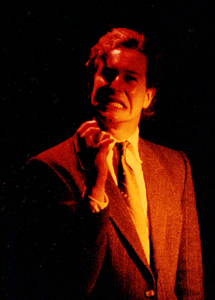
Splattworks will publish sequential excepts from my somewhat experimental, very dark, and brutally surreal drama BOMBARDMENT, an Oregon Book Award Finalist. (Above is a production still from the 1991 world premiere.)

Why that play released at this time will be explained. Paraphrasing a better-known playwright, also writing about one of his plays, there actually is a method to the madness…if a little madness to the method.

But, for now…blame it on Radiohead. Or, as Radiohead might say, blame it on the Black Star…which is where this play definitely lives. On that, more tomorrow.

[To be continued]

Coda

One more note about the Oregon Book Awards, and then I’ll shut up and try to move on.

The night of the awards, my wife Deborah and I were sitting in the second row, a little to the right of the presenter, and next to Deborah sat a very charming older lady who was graciously excited about the evening, and who seemed to be pleased to know I’d been nominated. In front of me sat two of the other finalists–both good friends who I was very happy for–along with some other writer friends I hadn’t seen in some time–Jan Baross and Sharon Whitney. It all felt cozy and festive…and I was nervous as hell and completely convinced there was no way I was ever going to win.

So then Keith came out with a guitar, started doing my lines, and I became totally calm. I looked over at Deb and saw the comprehension wash over her. And what I thought was going to be terribly difficult–going up and speaking–wasn’t bad at all. (They had good monitors, and I felt my old radio voice coming back to me, which was kind of amusing since the play’s main character was a DJ and some of the background drew on my radio days. And I don’t know if it was the hall or they’d thrown a little reverb on the mike, but I got just enough slapback from where I was standing that I could hear a vague echo of what I was saying. Felt like I should have started singing “Mystery Train.”)

Afterwards, the older lady reached across Deb, took my hand, squeezed it, and gave me a megawatt smile. It was one of the nicest moments of a beautiful evening.

Later at the reception, I learned she was Dorothy Stafford, wife of the late poet William Stafford, whose work I dearly love and who took time to chat with me a reading in Northwest Portland years ago, when I’d first moved back to the Pacific Northwest after living in New York and New Orleans. It moves me now just to think of it. Mr. Stafford was Oregon class: real, sensitive, giving, and a writer who could crush and salve you with just a few lines. I remember coming away from that evening, some 18 years ago, and thinking: you know, it is kind of nice to be back–maybe this will work out.

Thanks for reminding me, Dorothy, of an Oregon we should never take for granted.

A Wavelength

All writers have special moments in their plays or books. Often they’re the same as that of the audience–the big turnaround, the climax, the descriptive passage that nails a moment. But sometimes, they’re just something that resonates with us and which comes to us with no warning, simply out of the dark.

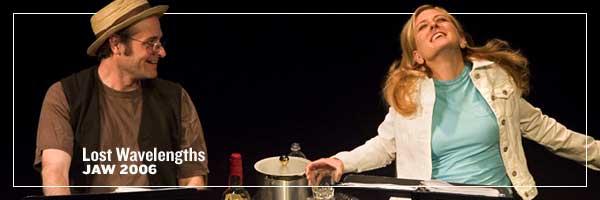
Lost Wavelengths, as you’ve probably heard me say, won the Oregon Book Award a week or so ago, an event which still kind of feels unreal. The OBA people asked me to send a sample that a presenter could read, in case I was lucky enough to be chosen, an I sent them kind of a funny passage of two characters starting to get to know each other. Then it turned out that only one person was reading–the marvelous Keith Scales–and he and the OBA people found probably the only monologue in the entire play.

It was grand, and people seemed to enjoy it (Keith did an outstanding performance), but it wasn’t my favorite moment in the piece. My favorite moment comes after two of the characters–Murray, a public radio DJ who travels around the country taping “outsider” musicians (musicians without any formal training or even musical knowledge but who are drawn to create…the musical equivalent of Grandma Moses or the Rev. Howard Finster), and Claudia, a radio reporter who’s doing a story on Murray–have spent an evening getting to know each other better than most subject/reporter relationships. They’re having a couple drinks, hanging out in a motel in Kansas, and the following, odd little exchange happens. I don’t know why I like it, but it was one of those moments when I was both inside the character, and the character went and surprised me. And, somehow, it seems to take on a ever slightly bigger meaning to me after the election.

MURRAY
Well, if they think of me at all back at the station, they’re not thinking this.

CLAUDIA
Not cutting an erotic swath through the Midwest?

MURRAY
Dorothy smoking a cigarette? (With post-coital languor) “Oh, Toto, Toto. It really is Kansas.”

CLAUDIA
It is.

MURRAY
Kansas is underrated.

CLAUDIA
It’s pretty much like everywhere else now. McJob, McHouse, McFamily. I ought to know: I’m from Nebraska. You either get absorbed or go crazy.

MURRAY
There! That’s why!

CLAUDIA
People flee, screaming, to New York?

MURRAY
No, no. That sameness. That Wal-mart, strip mall world. A bottomless cornucopia of market-researched tapioca. And still there’s people driven to make something new. Because they’re gifted or clueless or…possessed by Satan. Still there’s this voice under the surface, smothered but struggling. Gives me hope.

CLAUDIA
Of what?

MURRAY
They can’t own everything.

Third Time Around Dept.

(Photo by Owen Carey)

I’m pleased to announce that my play Lost Wavelengths has been chosen as a finalist for the Oregon Book Award, which is kind of like Oregon’s version of the Booker Prize. I couldn’t be happier to be in such distinguished company. I’ve twice been a finalist (for Bombardment and Altered States of America), and it’s both gratifying and humbling. Though everybody says it’s great to be nominated for this or that, the OBA is a case where, whether or not the play’s finally chosen, you’ve really already won just by being recognized. Thank you so much, Literary Arts!

Oregon Book Award Finalists