Dear Friends and Colleagues:
I’m writing to invite you to a rather special theatrical event. For 15 years, I’ve been working on a three-act drama Turquoise and Obsidian, which has been through countless drafts and private workshop readings, and had a public reading in 2003. Miracle Theatre Company has been kind enough to host Pavement Productions, my production company, in a concert reading of the finished script (if theatrical scripts are ever truly finished). The reading, on Sunday, November 4th, at 7:00, is free and has a wonderful cast slated, and it would be an honor to share the fruits of a long, fascinating process. Details follow below.
Thanks very much,
Steve Patterson
Pavement Productions
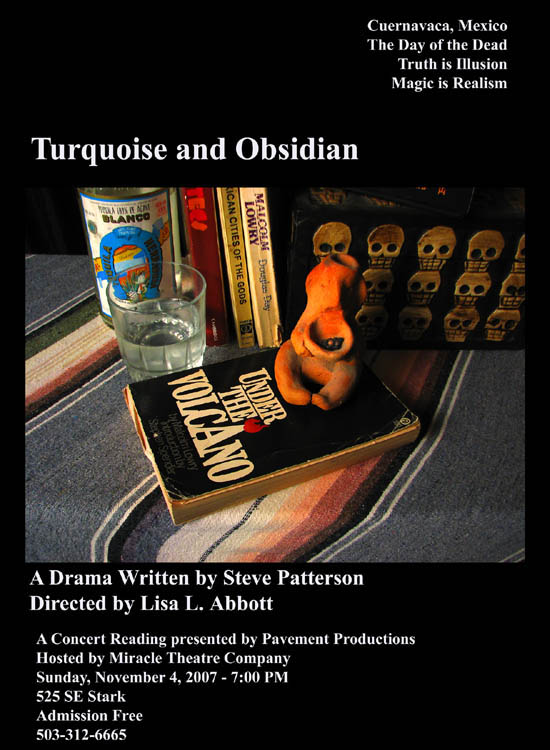
 PAVEMENT PRODUCTIONS, HOSTED BY MIRACLE THEATRE COMPANY, PRESENTS TURQUOISE AND OBSIDIAN
Pavement Productions presents a free reading of Portland playwright Steve Patterson’s original play Turquoise and Obsidian on Sunday, November 4th at 7:00 PM at Miracle Theatre Company, 525 SE Stark Street, Portland, Oregon. No reservations required. Scheduled cast includes Keith Scales, Mindy Logan, Rebecca Martinez, Noah Jordan, Roberto Astorga, and David Loftus.
ABOUT THE PLAY
Fifteen years in the making, Turquoise and Obsidian is a three-act drama about Zachary, a literature professor who becomes obsessed with the idea that he will die on the Day of the Dead in Cuernavaca, Mexico. The author of a celebrated critical analysis of Malcolm Lowry’s classic novel Under the Volcano (the protagonist of which dies on the Day of the Dead in Cuernavaca), Zachary feels trapped in a web of correspondences between the novel and his life. When he disappears into Mexico, his wife follows after him, setting off a story within a story involving Mexican politics, hidden Aztec culture, and a love story that, literally, encompasses the beginning and end of time.
Directed by Lisa L. Abbott, who has seen the play through many private readings and workshops with a veritable who’s who in Portland theatre, and a 2003 public reading featuring Keith Scales, Lorraine Bahr, and David Meyers, Turquoise and Obsidian involves six cultures (Irish, American, Mexican, Spanish, Native American, and Aztec), three languages (English, Spanish, and Nahuatl), and 500 years of history. Steeped in magical realism and a respect for native traditions, the creation of Turquoise and Obsidian was made possible by the Portland Civic Theatre Guild awarding Patterson its inaugural Theatre Fellowship, which allowed him to travel to Cuernavaca, experience the Day of the Dead first hand, and visit the original settings of Under the Volcano (including a stay in the apartment where Lowry wrote much of the novel—the building now being a hotel).
In 1984, Under the Volcano, considered one of the 20th Century’s greatest novels, was made into a film directed by John Huston and starring Albert Finney.
ABOUT THE AUTHOR
Since 1990, Steve Patterson has written more than 30 plays. Known for its rich word play, surreal imagery, and willingness to explore the unknown, his work has been performed in Portland, Chicago, Tampa, Austin, Los Angeles, Boulder, and other American cities as well as in Canada and New Zealand. His plays Bombardment and Altered States of America have been finalists for the Oregon Book Award, and, in 1998, Stark Raving Theatre won a $10,000 grant from the Flint Ridge Foundation for production of his play Liberation. In 2003, Rude Guerrilla Theatre Company’s production of Liberation was cited by Theatre Y2K.com for an Honorable Mention as one of that year’s best productions in Los Angeles. In 2006, his play Lost Wavelengths had a mainstage reading at Portland Center Stage’s JAW/West festival. Mr. Patterson’s other plays include: The Continuing Adventures of Mr. Grandamnus, Controlled Burn, Delusion of Darkness, Deuces, Malaria, Shelter, Temptation, Curl of Smoke, and Waiting on Sean Flynn. Both Delusion of Darkness and Waiting on Sean Flynn have been performed in the Tampa Performing Arts Center, the largest performing arts facility in the Southeastern United States. With Chris Harder, he co-authored The Centering, for which Harder won a 2007 Drammy for Best Actor. He is a member of Portland Center Stage’s PlayGroup Playwrights Workshop, the Dramatists Guild, and a former board member of the Northwest Playwrights Guild. He also the Co-Founder, Co-Artistic Director, and Resident Playwright of Pavement Productions.
ABOUT THE DIRECTOR
Lisa L. Abbott, Co-Artistic Director of Pavement Productions, has directed Pavement’s shows since 1997, including Life and Death on the American Road, Between the Sheets, and Curl of Smoke. Her work is known for its insightful character development, fine ensemble playing, creative use of theater space, and skillful integration of lighting and sound effects. Ms Abbott’s work as a director has focused on the development of new scripts, including Lost Wavelengths at Portland Center Stage’s JAW/West Festival and What Mad Pursuit at Classic Greek Theatre of Oregon. Her Portland directing credits include: The Centering for Chris Harder, A Grimm Late Night for Spectre Productions; and Liberation and Waiting on Sean Flynn for Stark Raving Theatre. Ms. Abbott has also directed in Chicago and Denver, where her credits include: Wolfbane; In Stiches; Interview, Audience; Slow Dance on the Killing Ground; and The Indian Wants the Bronx. Ms. Abbott has a MFA from the University of Portland, and has been an AEA Stage Manager and a guest director for the Chicago Dramatists’ Workshop.
ABOUT THE THEATRE COMPANIES
Miracle Theatre, sometimes known by the Spanish translation of its name Teatro Milagro, is the only Hispanic theater production company in the Pacific Northwest. Its home is in Portland, Oregon, though it often tours regionally and nationally. It was founded in 1985. The theater operates through three arms: the Miracle Mainstage, with English language productions at the company’s theater in South East Portland;, Teatro Milagro, the international touring company, with bilingual English/Spanish productions; and Bellas Artes, a multidisciplinary company that stages community-based events, such as annual Dia de Los Muertos, Posada festivals, and educational programs. The Miracle Theater generally produces about a half dozen productions of original and revival plays annually, along with related programs.
Pavement Productions is a small, independent Portland production company that specializes in developing and producing new plays. It has been especially successful in producing “anthology” shows composed of short plays written by a number of playwrights around specific themes. These have included Behind the Eyes, Between the Sheets, and the very popular Life and Death on the American Road. In association with The Bluestockings, Pavement plans to co-produce Dead of Winter, a trio of ghost stories for the stage, in February 2008.
For more information, contact Steve Patterson at 503-312-6665 or splatterson@mindspring.com



 Steve Patterson's Splatterverse