NEA – Quick Note


Jesus…it’s taken a bit of sleuthing, but I thought I’d let people know that the $50million in stimulus money set aside for the NEA by the House survived the House/Senate conference intact. It takes some looking, but you can see a summary of funding here.

So…it’s a miracle. Whew. Now just pass the fucker, let Obama sign it, and let’s get on with our lives already.

S

Dear John…

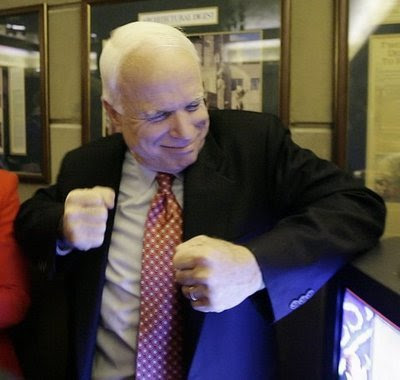
John McCain gets down to the rock’n’roll these kids are talking about….

There’s a group on Facebook sending letters to good old (old) John McCain (R-PTSD) about what artists do as he recently said: “$50 million in funding for the National Endowment for the Arts — all of us are for the arts,” McCain said. “Tell me how that creates any significant number of jobs?”

This is an important matter. It is also an irresistable opportunity for snark. Consequently, here’s my “Dear John” letter. The whole thing wouldn’t fit on the Facebook page, but this is the entire message I sent to him. I can’t wait to hear back!

——————–

Dear John– I understand you are not aware of how funding for the arts creates jobs. So, I’d like to tell you what I do for a living.

I am a playwright. I write plays for theatres to produce. When a theatre agrees to produce one of my plays, they pay me a fee, which I use to pay my mortgage. When I pay my mortgage, that’s one less home going into default and one less bad loan that has to be covered by the government to prevent the financial system from collapsing.

Also when a theatre produces one of my plays, they hire a director, actors, set designers, light designers, property designers, sound designers, stage managers, box office managers, public relations professionals (who disperse money for advertising), and other theatre professionals, many of whom have advanced degrees from universities who have received their tuition.

When a patron chooses to come see my play, they buy a ticket or tickets. They and their friends may also choose to have dinner before the play, which means they go to restaurants, order food, tip waiters and waitresses, and so on. If they drive, they purchase gas to operate their automobiles and often they pay for parking. Many times, if my play has entertained them or provoked discussion, they will go for a drink afterwards, which usually means they spend a few bucks. You like to have a drink now and then, right? And they often make plans to see their friends again, which means they’ll get together and do something at a later date, which usually entails spending more money. To get home, they’ll either drive, or maybe they’ll pay for a taxi. Or, even if they’ve had one or two drinks too many, are tired, or are visiting from out of town, they’ll stay a hotel that night.

People even sometimes fly in from out of town to see one of my shows, which not only involves staying in hotels but requires purchasing airline tickets. So that’s how a silly little bit of “entertainment” affects the economy. Clearly, I should charge more for my plays.

But then, I think you know all that, and you’re just playing politics with the whole
arts issue because a good many of your supporters feel that the arts industry is dominated by liberals, and, as they’re conservatives, singling out the arts is a way to “stick” it to the opposition while pretending to be a great defender of the budget. But we’ll just leave that little inconvenient wrinkle between the two of us, uh?

Thank you so much for asking what I do. One of the traits that helps playwrights do our work is staying informed as to how the world, including politics, works. So I do. It comes in handy when I’m writing. Especially about politics.

Sincerely,

Steve Patterson
Playwright
Portland, Oregon

Why do we stay?

My friend and colleague, Ami Sallee Corley (a superb actress who’s played the leads in my plays “Waiting on Sean Flynn” and “Delusion of Darkness” at Tampa’s Jobsite Theater), has been invited to begin blogging on the arts for Tampa’s Website “Creative Loafing.” Her first column asks a question that I think artists in Portland…and in Minneapolis, Seattle, Austin, etc., can identify with, which is: when it’s so tough to make a living from your art in your community, why stay?

Why do we stay?

(Possible Answer: It’s Tampa. The cigars, of course.)

Next weekend, representatives from the Dramatists Guild are coming to Portland to hold a Playwrights/Theatre Town Hall Meeting, and this may well be a pertinent question to ask, given that they have members in communities across the country and are privy to this dilemma and the many ways artists have found to address it.

Steve

More Obama/Arts Tea Leaves

Here’s an intriguing idea on the arts, from an guest editorial in the New York Times. Arts Czar, anyone? (Maybe in some kind of pseudo-uniform like C. Everett Coop used to wear as Surgeon General…a splattered painter’s smock with epaulets, folk art yarn sash, Kaiser Wilhelm spiked helmet decorated in day-glo swirls and rhinestones with a silvery papier mache bird’s nest riding the spike. One hand thrusting a dripping paintbrush forward above Ralph Steadman spattered lettering of: I WANT YOU.)

PUT CULTURE IN THE CABINET

By WILLIAM R. FERRIS
Published: December 26, 2008
Chapel Hill, N.C.

IN 1935, as part of the New Deal, President Franklin Roosevelt created the Farm Security Administration, which reached out to rural families as they struggled during the Depression. Roy Stryker, who oversaw the agency’s photo documentary program, captured the strength of American culture in the depths of the country’s despair. The photographs of Walker Evans, Dorothea Lange and Gordon Parks showed us both the pain of America and the resilience of its people.

In 1965, President Lyndon Johnson drew on his Texas roots when he created the National Endowment for the Arts and the National Endowment for the Humanities, organizations that share America’s arts and humanities with the American people.

Both Roosevelt and Johnson demonstrated their forceful commitment to the preservation and celebration of American culture — and they did so in challenging times.

So what will President-elect Barack Obama do? Well, here’s a suggestion.

Over the years, America has developed an impressive array of federal cultural programs — in addition to the endowments for the arts and the humanities. These include the Corporation for Public Broadcasting, the Institute of Museum and Library Services, the Library of Congress, the National Archives, NPR, PBS and the Smithsonian Institution.

Each of these organizations has helped preserve our nation’s rich folklore — its music, stories and traditional arts — as a uniquely powerful voice for our culture.

But as chairman of the National Endowment for the Humanities from 1997 to 2001, I learned firsthand that these institutions, though united by a shared goal, can sometimes run into conflict with one another. There were bureaucratic tangles, overlaps and missteps that, with foresight, could have been avoided.

Which is why I believe the president should create a cabinet-level position — a secretary of culture — to provide more cohesive leadership for these impressive programs and to assure that they receive the recognition and financing they deserve.

The president should initiate another change, too. The leaders of our cultural institutions should all have renewable 10-year appointments. (Some now serve only four-year terms.) Such a change would help to provide continuity and insulate the organizations from the tumult of political change. This move would allow each agency to develop long-term agendas in coordination with the secretary of culture in each administration.

Mr. Obama has an opportunity to revitalize our national spirit by strengthening our cultural programs at every level. It’s hard to imagine what could be a more important — and enduring — legacy.

William R. Ferris is the senior associate director of the Center for the Study of the American South at the University of North Carolina at Chapel Hill.

What’s In It For Me Dept.

Amid the lightning and thunder of the Wall Street and Big Three bailouts, there hasn’t been much talk about Obama’s possible impact on the arts. I have heard Caroline Kennedy’s name bandied about as a possible NEA chairmain, but, by God, she’s getting some kind of job since just about everybody wants her for something.

Anyway, I ran across this bit on a piece about Obama’s economic sitmulus package that I thought was interesting:

Among the worst vestiges of the Clinton years was the linking of education spending to the nation’s technological advancement, downplaying the life-affirming, intrinsic value of culture. Since the Reagan Administration bulldozed federal arts and humanities funding, the nation’s entire cultural apparatus has become increasingly privatized.

Why shouldn’t the stimulus package fund arts groups and schools to hire at least 100,000 cultural workers? These workers can paint murals, teach art, dance, music, and theater, and provide the level of art support that existed in the United States from the New Deal through the Carter Administration.

The Obama transition team has already endorsed an ArtistCorp, though this appears separate from the stimulus package. But a Musicians National Service Initiative already exists, and could hire people with stimulus funds through its recently created MusicianCorp.

Hiring cultural workers would not only boost consumer purchasing power, but in doing so the Obama Administration would send a powerful message about the nation’s values. The United States should not be only about high-tech, infrastructure, and finance, and our cultural infrastructure deserves more than having its leaders honored annually at a Kennedy Center gala.

Dept. of Stupid Ideas

I was recently chatting with a friend about making music, theatre, etc., and we were both agreed that, yeah, it’d be cool if there was a place in the country you could go where you could crank up the amps, and folks could jam, try out new stuff. And pretty soon we were like…and yeah…we could do play readings! And workshops! And record! And a space for photographers! And…and…and…we need a barn! Or a rich friend with a barn. A rich patron of the arts with a barn. At which point, it devolved into some kind of mutant Mickey Rooney on acid let’s put on a show, and we laughed it off, and the conversation meandered into something equally silly….

But.

For some reason, I keep thinking about the barn. What if…there really was one out there? And someone was into it? You could kind of, I don’t know, do a co-opt thing where folks chipped in a few bucks to help defray costs, and you could have jams with a few invited friends, a pot-luck, a bit of theatre, a bit of music, and….

Yeah. It’s totally fucking nuts. But then, so am I, so I went a posted an inquiry on Portland Craigslist under “Artists.” I’m sure nothing will come of it. But…but…but….

Nevermind.

The Glamourous Life in the Arts


He spent more hours looking and thinking than he did painting. People who watched him say that he sometimes waited as long as twenty minutes between two strokes of his brush. He himself said that there were days when he looked at his subject so long that he felt “as if his eyes were bleeding.”

–Rousseau on Cezanne–