That Damned Fork

“I’ve had my freedom/but I don’t have much time”

O philosopher-king, what do you say of time in an age where there is none? Where a certain darkness clings to every surface like an undefinable scent? Every day a cigarette, burning towards the filter.

Want to keep smoking this one. Just this one.

Never been too light on my feet. Some seem to float through their days, but it’s always been a struggle for me, each morning another lifting into the light. It’s hard to let go of the dark; you see such interesting things there. The road forks, one way up the hill into bright sun, the other curving into a shaded grove, I know which way my feet will take me. Because somehow from a very early age, I guess I’ve always known this ends in the dark. Starts there, ends there. So maybe I’ve thought there were answers there. Maybe it’s just a proclivity. Sometimes it seems like the night is more honest, the days so loaded with bullshit.

When the lights go down in a theatre, it marks a beginning. A demarcation from the ordinary. It’s the everyday that cuts, whittles away. Could it be you don’t age in the dark? Or maybe it just doesn’t show quite so clearly.

The Glory that is Denial

We’re having a pre-production meeting for “Dead of Winter” today, which is great–it’ll be wonderful to get the ship up and running, and all the pieces are coming together nicely. It also means that’ll no longer be able to pretend that I’m not going to be a producer again.

Don’t get me wrong: I love producing. It’s like hammering together a ship out of balsa wood and seeing if you can get it through the rapids. When it works, it’s immensely satisfying. When it doesn’t…well, it doesn’t. This is more a feeling of inevitability, like knowing you’re really going to see the surgeon or walking into the final exam room. Because the switch flips, and, suddenly, it’s not your life anymore. You belong to the play. When I think of holding down a job, all the plays I have in progress and to market, and just the obligations of paying bills and going to the grocery store, I hear this tremendous sucking sound at the back of my brain, and my eyes pull back in their sockets, and all my energy ebbs from a hole at the bottom of my spine.

Or something like that.

On the other hand, I can look forward to the stuff that makes it worthwhile. One would think those are opening nights, getting good reviews, and counting the final box office, but, really, the small moments remain with you. The ones hanging around outside with the smoking brigade and telling theatre war stories. They’re finding these unexpected moments during rehearsal when everyone rocks back at once and goes “yes!” And they’re even that nth hour during tech week when you’re so goddamned tired that you’re beyond tired (and there’s no fatigue like theatre fatigue, baby, unless maybe it’s having a loved one in the hospital), and, man, you just can’t hack it, and suddenly something funny–or maybe just borderline funny–hits you, and you completely go to pieces with hysterical laughter. The kind where you can’t breathe and you’re begging it to stop and your cast and crew are looking at you like, uh, he’s the guy in charge…we are so screwed.

And then there’s the bar. The post-show bar is a strange and beautiful thing, where people tell each other the damndest, personal, stuff. When I think back on a dozen of my favorite productions, I see my comrades in that vaguely sallow bar light, with cigarettes burning and empty beer glasses flecked with foam. Their arms are around each other. They’re laughing or bitching or some combination of the two. And that’s when I think, Patterson, you’re a very lucky guy.

Status Report

Here we are, coming down to the end of the year, and where the hell am I?

Well…busy. Upcoming production of “Dead of Winter” in Portland, come February. “Waiting on Sean Flynn” goes up in Detroit in March, and a short piece is scheduled to be part of a “Seven Deadly Sins” show in L.A. in May (my sin is greed, which I know practically nothing about). Reading 10-minute plays based on/insprired by Pere Ubu, an amazing stack of stuff with more coming in every day, for a reading and possible production next year. Plus a TBA production for June. Working on some other super secret for your eyes only projects that, ahem, of course I can’t reveal at the moment.

After a long bout of writer’s block–very uncharacteristic for me, been writing like a bastard. Since summer, first drafts of a surreal one hour, one-act called “Farmhouse”; a shorter one-act about politics tentatively called “Night Flight from Houston”; a serious two-act called “Next of Kin”; and a rather unhinged two-act called (wait for it)…”Rimbaud’s Daughter in Louisiana (or the Drunken Pirogue.” Christ. What the hell’s wrong with me?

A bunch of stuff out with theatres that I’m waiting to hear on (a feeling akin to being stuck on the tarmac sans AC in August), but it’s time to get back on the marketing bandwagon, so I figure I’ll take some of the Christmas holidays to get some queries stuffed in envelopes. When I look at the backlog, I must have at least four or five full-lengths that have been done and that I’m comfortable shopping around, and it’s time to hunt premieres for “Lost Wavelengths” and “Turquoise and Obsidian.” Of course, still searching for that elusive New York production. And, when I take a deep breath, I sometimes think about the joys of pursuing an agent, but then this kind of gray and purple, Jackson Pollock mist slithers into my brain and my eyes glaze over and my head lists slightly to the side and drool begins to drip from my open mouth….

Jesus, Patterson, we don’t have the slightest idea what the hell you’re talking about! You writers are so goddamned self-involved! Get back to…dissing politicians or something.

Okay. Scott McClellan, Bush’s former press secretary, is coming out with a new book in which he says, yeah, yeah, we all knew who outed Valerie Plame and it was the president and vice-president, and I stood in front of everybody and lied my ass off, but it was my job, all right, and, by the way, the president is a filthy liar. Liar, liar, liar.

But then, you already knew that.

The Revolution in Turnaround

As a committed (re: otherwise unemployable) theatre artist, I can say with confidence the money’s in TV and film. People ask me why I don’t work in those mediums, and my standard line is that, yeah, you make the money, but you spend it all on shrink bills. Actually, in theatre, you have more control of your words, working live is fun and vibrant, there’s more latitude for weirdness, and your colleagues treat you with respect (sometimes embarrassingly so) rather than as the janitor.

Mostly though, Hollywood scares the shit out of me.

So I’m neither a member of the Writers Guild of America nor on strike. I’m a member of the Dramatists Guild of America, which is kind of like being a Democrat–not being a member of an organized group.*

I have friends in the film industry, and I’m worried about them: this strike looks to be a tough, protracted one. And I know shows like “Law and Order,” “CSI,” and “Gray’s Anatomy” keep a lot of playwrights afloat.

But I can’t help wondering what the strike means for theatre, particularly if it lasts into next year. People will certainly spend the winter catching up on DVDs they’ve meant to watch, but, at a certain point, could their hungry minds be turned to…the stage?

It won’t affect the programming of full-season theatres, which plan a year or two ahead, but it might affect rough-and-tumble indie theatres, whose ticket prices are closer to first-run movies. Could this be a golden opportunity for new, adventurous theatre companies doing new, adventurous plays, building a whole new audience from dedicated moviegoers who never realized theatre could be so dynamic and well done? Could it, in short, mark the beginning of a bold new age, a theatrical renaissance for new works and writers? A time we will all look back upon with gleaming eyes and churning hearts? Could it? Just maybe?

Nah.


*A cheap and easy joke, stolen from Will Rogers; I’m actually very fond of the Guild; they’ve been very good to me and do wonderful things. Still applies to the Democrats, however.

Guided by Voices


No one asks me to teach playwriting. That’s probably because my academic credentials qualify me to shout rude questions at weary press secretaries, not misguide young minds. It’s just as well since my answer to inquiries such as “How do I get a play produced?” is “Write a good one.” That’ll be _________ dollars.

But if some misguided administrator actually asked me to teach a seminar or something, I guess I’d title it “Listening to Voices” simply because I know a play has a chance if I can hear the voices of distinctive characters.

That’s all a playwright has, really. You can develop any number of scenarios, but how those play out depend on what kind of people your characters are, and the only way you can tell them apart is by the way they speak. Suppose your character stows away aboard a spacecraft. You’re in for one kind of play if, when discovered, your character says:

Please, man, please. All I ever wanted to be was an astronaut. But everybody said I was, you know, stupid. I won’t touch anything. Honest.

As opposed to a character who says:

Well, hell, you found me. Guess we’re stuck with each other. Might well rock’n’roll. Have a snort. But be careful. I get stingy with my supplies when I get past the Van Allen belt.

Not that I’d recommend writing either play; we have too many spacecraft stowaway dramas as it is, right? It’s just that in a dialogue-driven medium such as theatre, voice is destiny. Once it was customary to refer to playwrights as the “gods of theatre” (and a lot of us are irritated about being demoted to “necessary evil” in some quarters), but the truth is we’ve always pretty much been stenographers to the unconscious.

Which is to say, at least for me, I don’t have the slightest idea where the voices come from. I can tell, however, when they aren’t cooperating because everyone ends up sounding the same. It’s one of the most common problems I see as a producer reading scripts; not only do the characters not have distinct personalities, but they’re not speaking to each other. Reading those plays is rather like getting cornered at a party by a monomaniac. Pretty soon, you can feel your smile muscles cramp as you glance at the clock or oh-so-casually look around from someone to rescue your ass.

A play’s a play, and an essay’s an essay.

In Portland: An Invite to a Special Theatrical Event

Dear Friends and Colleagues:

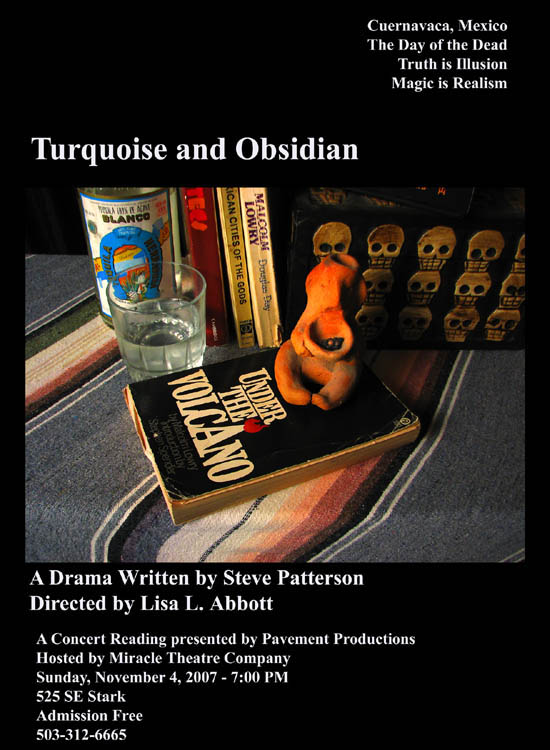
I’m writing to invite you to a rather special theatrical event. For 15 years, I’ve been working on a three-act drama Turquoise and Obsidian, which has been through countless drafts and private workshop readings, and had a public reading in 2003. Miracle Theatre Company has been kind enough to host Pavement Productions, my production company, in a concert reading of the finished script (if theatrical scripts are ever truly finished). The reading, on Sunday, November 4th, at 7:00, is free and has a wonderful cast slated, and it would be an honor to share the fruits of a long, fascinating process. Details follow below.

Thanks very much,

Steve Patterson
Pavement Productions
PAVEMENT PRODUCTIONS, HOSTED BY MIRACLE THEATRE COMPANY, PRESENTS TURQUOISE AND OBSIDIAN

Pavement Productions presents a free reading of Portland playwright Steve Patterson’s original play Turquoise and Obsidian on Sunday, November 4th at 7:00 PM at Miracle Theatre Company, 525 SE Stark Street, Portland, Oregon. No reservations required. Scheduled cast includes Keith Scales, Mindy Logan, Rebecca Martinez, Noah Jordan, Roberto Astorga, and David Loftus.

ABOUT THE PLAY
Fifteen years in the making, Turquoise and Obsidian is a three-act drama about Zachary, a literature professor who becomes obsessed with the idea that he will die on the Day of the Dead in Cuernavaca, Mexico. The author of a celebrated critical analysis of Malcolm Lowry’s classic novel Under the Volcano (the protagonist of which dies on the Day of the Dead in Cuernavaca), Zachary feels trapped in a web of correspondences between the novel and his life. When he disappears into Mexico, his wife follows after him, setting off a story within a story involving Mexican politics, hidden Aztec culture, and a love story that, literally, encompasses the beginning and end of time.

Directed by Lisa L. Abbott, who has seen the play through many private readings and workshops with a veritable who’s who in Portland theatre, and a 2003 public reading featuring Keith Scales, Lorraine Bahr, and David Meyers, Turquoise and Obsidian involves six cultures (Irish, American, Mexican, Spanish, Native American, and Aztec), three languages (English, Spanish, and Nahuatl), and 500 years of history. Steeped in magical realism and a respect for native traditions, the creation of Turquoise and Obsidian was made possible by the Portland Civic Theatre Guild awarding Patterson its inaugural Theatre Fellowship, which allowed him to travel to Cuernavaca, experience the Day of the Dead first hand, and visit the original settings of Under the Volcano (including a stay in the apartment where Lowry wrote much of the novel—the building now being a hotel).

In 1984, Under the Volcano, considered one of the 20th Century’s greatest novels, was made into a film directed by John Huston and starring Albert Finney.

ABOUT THE AUTHOR
Since 1990, Steve Patterson has written more than 30 plays. Known for its rich word play, surreal imagery, and willingness to explore the unknown, his work has been performed in Portland, Chicago, Tampa, Austin, Los Angeles, Boulder, and other American cities as well as in Canada and New Zealand. His plays Bombardment and Altered States of America have been finalists for the Oregon Book Award, and, in 1998, Stark Raving Theatre won a $10,000 grant from the Flint Ridge Foundation for production of his play Liberation. In 2003, Rude Guerrilla Theatre Company’s production of Liberation was cited by Theatre Y2K.com for an Honorable Mention as one of that year’s best productions in Los Angeles. In 2006, his play Lost Wavelengths had a mainstage reading at Portland Center Stage’s JAW/West festival. Mr. Patterson’s other plays include: The Continuing Adventures of Mr. Grandamnus, Controlled Burn, Delusion of Darkness, Deuces, Malaria, Shelter, Temptation, Curl of Smoke, and Waiting on Sean Flynn. Both Delusion of Darkness and Waiting on Sean Flynn have been performed in the Tampa Performing Arts Center, the largest performing arts facility in the Southeastern United States. With Chris Harder, he co-authored The Centering, for which Harder won a 2007 Drammy for Best Actor. He is a member of Portland Center Stage’s PlayGroup Playwrights Workshop, the Dramatists Guild, and a former board member of the Northwest Playwrights Guild. He also the Co-Founder, Co-Artistic Director, and Resident Playwright of Pavement Productions.

ABOUT THE DIRECTOR
Lisa L. Abbott, Co-Artistic Director of Pavement Productions, has directed Pavement’s shows since 1997, including Life and Death on the American Road, Between the Sheets, and Curl of Smoke. Her work is known for its insightful character development, fine ensemble playing, creative use of theater space, and skillful integration of lighting and sound effects. Ms Abbott’s work as a director has focused on the development of new scripts, including Lost Wavelengths at Portland Center Stage’s JAW/West Festival and What Mad Pursuit at Classic Greek Theatre of Oregon. Her Portland directing credits include: The Centering for Chris Harder, A Grimm Late Night for Spectre Productions; and Liberation and Waiting on Sean Flynn for Stark Raving Theatre. Ms. Abbott has also directed in Chicago and Denver, where her credits include: Wolfbane; In Stiches; Interview, Audience; Slow Dance on the Killing Ground; and The Indian Wants the Bronx. Ms. Abbott has a MFA from the University of Portland, and has been an AEA Stage Manager and a guest director for the Chicago Dramatists’ Workshop.

ABOUT THE THEATRE COMPANIES

Miracle Theatre, sometimes known by the Spanish translation of its name Teatro Milagro, is the only Hispanic theater production company in the Pacific Northwest. Its home is in Portland, Oregon, though it often tours regionally and nationally. It was founded in 1985. The theater operates through three arms: the Miracle Mainstage, with English language productions at the company’s theater in South East Portland;, Teatro Milagro, the international touring company, with bilingual English/Spanish productions; and Bellas Artes, a multidisciplinary company that stages community-based events, such as annual Dia de Los Muertos, Posada festivals, and educational programs. The Miracle Theater generally produces about a half dozen productions of original and revival plays annually, along with related programs.

Pavement Productions is a small, independent Portland production company that specializes in developing and producing new plays. It has been especially successful in producing “anthology” shows composed of short plays written by a number of playwrights around specific themes. These have included Behind the Eyes, Between the Sheets, and the very popular Life and Death on the American Road. In association with The Bluestockings, Pavement plans to co-produce Dead of Winter, a trio of ghost stories for the stage, in February 2008.

For more information, contact Steve Patterson at 503-312-6665 or splatterson@mindspring.com

Wearing the Producer’s Hat

It’s pointy, like the ones they used to make bad kids wear at school, and it never quite fits right, always slipping down over your eyes at inopportune moments.

Last time I counted, I think I’ve produced 25 shows, only one of which failed to break even. I think that’s a decent track record for a frankly perilous endeavor. The last time around was so completely exhausting and disappointing–in terms of ticket sales, artistically it was excellent, which made the small audiences even more frustrating–that I put the pointy hat on the shelf for five years and concentrated on writing plays and letting others produce them.

Part of the reason, however, that I got into producing was that I just wasn’t seeing certain kinds of plays–strange, unkempt, orignal–being produced in Portland. There’s a lot more work being produced here these days; so much so that it’s hard to see everything one would like. This time, I’m dusting off the pointy hat because I want to produce something that seems like a total blast and an easy sell. In other words, I’m in it for the fun.

That is, next February, my company Pavement Productions is co-producing with Portland’s The Bluestockings three ghost stories I’ve written for the stage: Whitechapel, Wet Paint, and The Body. The whole evening will be called Dead of Winter (going up in February), and every time I tell someone about it, they get that weird sparkle in their eyes that tells me it’s a good idea (and people will come). When you can write the press release in your head, you’re on the right track.

The thing about producing is this: it will take you over. You are the go-to person when things go wrong, when little things need attention, and there are always details that have to be addressed, whether it’s making sure you make press deadlines or procure that goofy little prop no one seems to be able to find. It’s taught me a decent lesson about life, though: when you think you can’t give anymore, push a little harder, and you’ll find you have more to give. It’s an opening to a process bigger than yourself. That’s why it’s tough. That’s why it’s also rewarding. And when the pieces come together and things go right, it’s a wonderful, hard-charging high. As Neil Young sings: “With trunks of memories still to come.”

And there’s always that last moment, when the show is over and the set’s been struck, and you’re done with cleaning up the trash and boxing up the pieces, when you’re alone in the theatre for the last time and have to turn out the lights. That moment belongs to the producer alone. That moment can be worth the journey.